
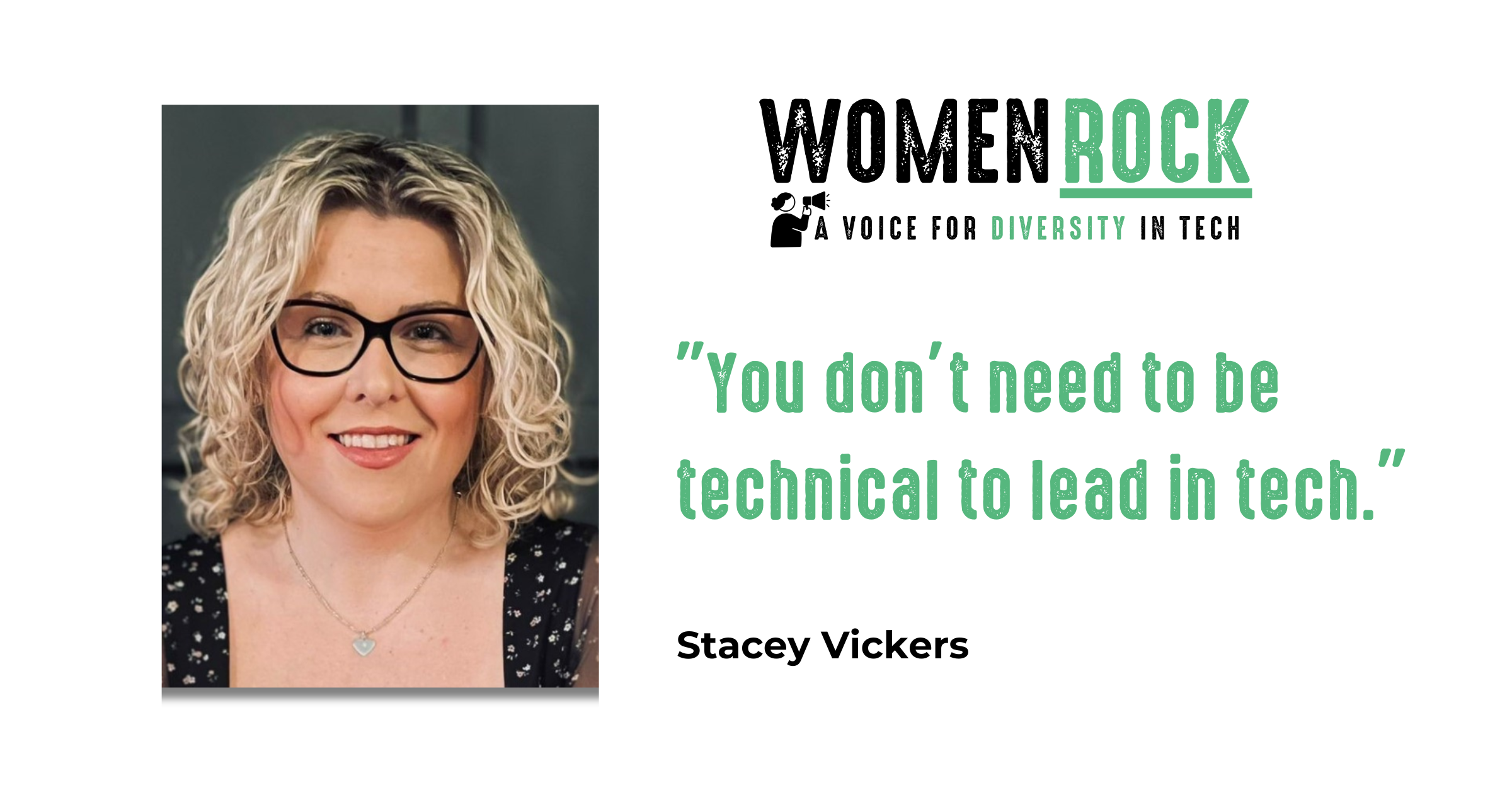
Not every career in tech starts with code – and Stacey Vickers is a powerful example of why that matters.
As Head of Growth & Strategic Partnerships at Transform, Stacey plays a pivotal role in bringing people, ideas and capabilities together to solve complex challenges across the public sector.
With a background far removed from technology, Stacey has built a career on curiosity, trust and connection, working closely with highly technical teams without needing to be the technical expert herself. In this interview, she shares her unconventional path into tech consultancy, how she’s built credibility in male-dominated environments, and why non-technical perspectives are not just welcome in tech – they’re essential.
You describe yourself as someone who connects people, ideas and opportunities. How did your career begin, and what led you into tech consultancy without a technical background?
My career didn’t start with a grand plan. After studying Law & Criminology – a world that has absolutely nothing to do with what I do now – I left university with no clear direction. I’d spent years working in retail and hospitality, which taught me a huge amount, but I knew they weren’t long-term paths for me. The next logical step felt like “getting an office job”, so I took a Sales Coordinator role at a small local business.
That’s where everything clicked. I realised that the part I’d loved most about my earlier jobs – connecting with people – was actually a strength. I worked in a tiny two-woman team, and my boss at the time became a real mentor. She showed me the craft behind relationship-building: how to really get to know clients and suppliers, how to network with intention, and how trust is created through genuine connection.
From there, I moved through various business development and account management roles, eventually landing in the employee research space – an unexpected detour, but one I genuinely enjoyed. The consultancy I worked for merged with a tech and data consultancy (now Transform), and suddenly I found myself in an entirely unfamiliar world.
I’ll be honest: tech isn’t a sector I would have chosen for myself. But I was quickly hooked. I loved seeing how we solved knotty, complex problems inside major public-sector organisations, and how those solutions had a tangible impact on services that we all rely on every day.
Now, as Head of Growth & Strategic Partnerships, I get to lean fully into what comes naturally to me: curiosity, relationship-building and connecting dots. My role is essentially matchmaking: understanding our own capabilities and what potential partners bring – and bringing the right people and ideas together to create solutions that genuinely move the needle. It’s not where I expected my career to go, but it’s absolutely where I’m meant to be.
When you first started at Transform, what was the hardest part of working with technical teams, and how did you earn their trust?
Starting at Transform was a real jolt to the system. I’d come from being an SME in the employee research world – confident, knowledgeable, and finally feeling like I’d quietened the imposter syndrome – and suddenly I was somewhere I knew absolutely nothing.
The technical world is vast. It’s not just the technology or the jargon; it’s the sheer range of roles, disciplines and processes that all interlock. To speak credibly with clients and partners, you need enough understanding to open doors – but also the humility to know you’ll never know everything.
So that’s where I started: by spending time with our teams. I made a point of getting to know people, the projects they were delivering, and the work that genuinely excited them. I didn’t try to bluff my way through conversations or pretend I understood things I didn’t (as tempting as that can be when you feel out of your depth.) I asked the so-called “stupid questions”, showed real curiosity, and made sure the right experts were involved.
That approach became the foundation of trust. Teams could see that I wasn’t going to over-promise or put them in difficult situations just to win work. They knew I’d bring them in early, work alongside them to understand the problem properly, and keep everyone aligned. Over time, that consistency built credibility – not because I became a technical expert, but because I respected their expertise and always had their backs.
You often work with male-dominated technical groups. How do you show leadership and credibility without being the technical expert?
For me, leadership has never been about trying to out-expert anyone. One of the biggest misconceptions is that you need to be the loudest voice in the room or “fake it until you make it”. In my experience, that rarely builds credibility.
What’s made the biggest difference is something much quieter: listening. Early in my career, I took an active-listening course and quickly realised how bad I was at it. I was so focused on thinking of the right question that I wasn’t really hearing what people were saying.
So I practised. I learned to be present, to let conversations breathe, and to listen for what people were really trying to communicate. As a result, my contributions changed. I asked better questions, connected ideas more effectively, and helped groups move forward in a thoughtful and grounded way.
Credibility doesn’t come from technical expertise alone. For me, it comes from creating the conditions for expertise to thrive – bringing the right people together, giving them space to think, and helping them align around a shared problem. I’m there to facilitate and amplify their brilliance, not compete with it.
Has there been a moment where your non-technical background became a strength?
Absolutely. Clients often feel comfortable being very open with me because I sit slightly outside the technical detail. I’m there to listen, understand what they really need, and make sure the wider team can support them. That distance can make conversations feel safer and more human.
It’s also valuable in procurement and bidding work. I’m not writing the technical sections, but I can review them with fresh eyes. That often means spotting where something isn’t clear, or asking a question that helps the team explain their thinking more simply or compellingly.
My non-technical background doesn’t give me special insight – it just gives me a different perspective. And sometimes, that’s exactly what’s needed.
What challenges do women and non-technical professionals face in tech consultancy, and what advice would you give them?
For women entering tech consultancy, one of the biggest challenges is still the culture. It’s a male-dominated industry, and that can feel intimidating early on (although there’s real energy and investment going into changing this.)
There’s also an internal challenge: the feeling that you’re “ticking a box”, or taking a place that should belong to someone more technical, more experienced, or simply more male. At Transform, we hire diverse teams because we know different perspectives lead to better outcomes.
There’s also a misconception that you need to be deeply technical to succeed in tech consultancy. You don’t. There are so many roles that shape great outcomes. My own technical proficiency pretty much ends at my phone, laptop and slightly unreliable smart-home gadgets – yet my perspective still adds value.
Teams rely on strategists, designers, delivery leads, researchers and relationship-builders just as much as engineers and data specialists. That’s why one of our core values is “we’re all in.”
My advice? Don’t count yourself out. Ask the questions you think sound silly. Stay curious. Be open to learning. Trust that your contribution is not only valid but essential.
What does a typical day look like for you at Transform?
Conversations. Lots of them.
That might sound unproductive to some, but it’s the heart of my role. Whether I’m responding to an internal brief or exploring a new opportunity with a client or partner, my instinct is to bring the right people together.
I’m not here to write code or engineer solutions, I’m here to build the team that can. My job is to understand people’s strengths, spot gaps, and connect colleagues and partners in ways that make meaningful progress possible.
There’s admin behind the scenes, of course, but the real value comes from relationships. And I feel incredibly lucky that the work that energises me most is also the core of my role.
Outside of work, how do you recharge?
Spending time with my family recharges me more than anything. Being around a four-year-old with endless enthusiasm forces me to switch off and be fully present.
I also love the gym. Movement is essential for my mental and physical health. Earlier this year I took part in a Hyrox-style event – running combined with functional workouts – and it was one of the hardest things I’ve ever done. Crossing that finish line was incredibly satisfying.
One of my core values is achievement. So anything that gives me that feeling of “I did it” – whether it’s a fitness challenge or cooking a meal my family loves – really fuels me.
What advice would you give your younger self at the start of your consultancy career?
Get comfortable with not knowing all the answers. You don’t need certainty to succeed. What matters is curiosity, humility, and knowing who to learn from and collaborate with. A strong network will take you far further than confidence alone ever will.
📚 Book Recommendation
Time to Think – Nancy Kline
This book genuinely changed the way I think about myself, other people and how we make the most of the time we spend together. It showed me the power of reflection and the importance of giving others the space to think. Everyone is capable of brilliant insights when given the conditions to do so.
💬 Favourite Quote
“A woman is like a tea bag — you never know how strong she is until she gets in hot water.”
– Eleanor Roosevelt